
Respect
Do you ever get lost in trying to understand a dictionary definition for something?

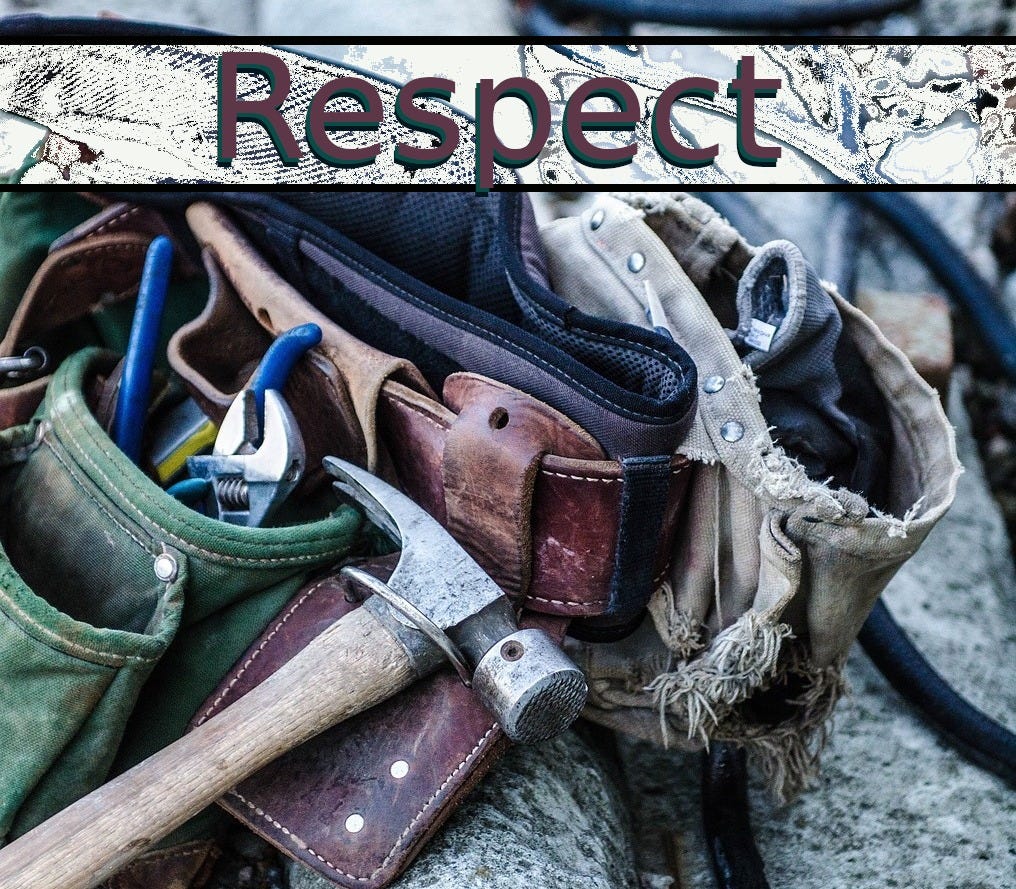
  Do you ever get lost in trying to understand a dictionary definition for something? Even a word that most people would say they understand?

  Take ‘respect’ for instance. A quick search turns up these three options:

1. A feeling of appreciation, often deferential regard, esteem.

2. The state of being regarded with honor or esteem.

3. Consideration or appreciation.

  I can muddle through it, but really, I got a little lost at ‘deferential regard.’

  So, in the mood to chase word-meaning rabbit-trails, I set out to clarify deferential, and ended up searching out the definitions for esteem, courtesy, and regard as well. Might as well be thorough, I suppose...

  But why am I going on about respect?

  Well, because this is a Father’s Day post in February, of course. Why else? And the subject of respect fits quite well in a Father’s Day post, I think.
But on to the questions!
  When I think of respect, these are the questions that I come up with:

  What is someone really asking for, when they want to be treated with respect? When you say, “I respect him,” about someone else, what does that boil down to?

  In the arguments between younger and older, where both are demanding respect, what are they each refusing to give to the other?

  Which aspects of respect should be a given to every person you meet, and which can only be earned?

  For the purpose of getting to the heart of those questions, at least a little, this is my delve into the definitions of the day.

  Firstly: Deference.

  Deference can mean courtesy (also known as politeness), esteem (which has an implication of valuing or prizing), or regard (which has too many definitions, but can mean to give heed to or pay attention to). It can also be used to note a tendency to yield to someone else’s will or plan.

  So, holding that alongside the baseline definition of respect and expanding on it a little, we can try to nail down some of the aspects of what respect can look like.
Some Answers
  Respect can start with a feeling of appreciation (see definition 1). It can look like appreciating someone’s skills and abilities, their sense of humor, or simply their innate worth as a human being.

  In regards to courtesy, respect might mean being polite to that person as a baseline way of treating them, not waiting for them to ‘earn’ it, no matter how rude they seem to you.

  It could mean paying attention to another person’s words or actions, giving heed to what they think even if you disagree (going back to that definition of regard).

  Or, if you take regard to mean something else, respect can be then paired with affection – which is easier if you are talking about respecting a family member whom you at least like a little bit. The two go well together, usually.

  Another aspect of respect is the reference to ‘esteem.’ That might look like finding things to prize or value about the person you are trying to give respect to. To find reasons to think highly of them, if you can.

  In some cases, respect can show up as consideration. Allowing that person to finish what they were saying before jumping in, or allowing them to go before you. Which can, of course, be difficult to maintain if you don’t feel you’re being offered the same consideration.

  And finally, respect can look like honoring someone. Yes, as in: “Honor your father and mother.” (Which has its own set of definitions, not to be gotten into right now).

 I will say, that in one of those curiosities of life, the respect we hand out to people seems to have as much to do with our own attitudes and hearts as it has to do with them (Which is rather fitting with God’s way of doing things, I suppose). But also that it is much easier to show respect to others if they show courtesy or respect to us first, or we’ve seen excellent examples of how to show respect to those who don’t reflect it back.

  Which leaves us back at one of those questions from earlier. Which came first, the chicken or the egg? Who should be showing respect first? Do we really have the right to demand respect, or should be we more focused on giving it away than how much of it we’re receiving, and from who?

  That set of questions gets harder to live out once you walk into a world that is more complicated than this page. Because demanding respect does seem reasonable at times. And sometimes you just don’t like that person you're supposed to respect. And sometimes you have to find a way to disagree with them respectfully. And then there’s those situations where someone has done something to stomp on your esteem for them, or break your trust. Where does respect live in those situations?

  I don’t know.

  But my challenge for us this week is this, despite the questions:

   How can each of us treat just one person in our lives with more respect this week, in a way that we would value if we were in their shoes?


  What about for you? Does that mean more courtesy? More listening? Or simply letting someone know that you value them in some way? It doesn’t have to be a grand gesture, because respect is built in the simple things.

  Let me know your thoughts!
Thank you for enjoying this post from Mountain Chickadee! If this made you smile and you’d like to see more in the coming weeks, please consider subscribing to my Substack!
You've shared about a difficult subject, with as many meanings and variations as there are cultures. I do think culture plays a large role in respect. But one thing is certain, it means that you are acknowledging someone who has great importance in your life, and honoring them. Loved your thoughts!
You raise some interesting questions!
The Bible says to do good to all…could this be a root of respect? It seems doing good to someone implies some sort of respect???